
When we lived in Austria, we never really thought about water.
You turn on the tap.
Water comes out.
Done.
Where it comes from, how it is processed, and the route it has taken to get to the tap are not really of interest to anyone in everyday life.
Here in Baja California Sur, that's a bit different.
Here we need to know, where our water comes from, how we get it, and what happens to it afterwards.
And that’s exactly why water is now a pretty big issue here. Planning our house.
Our water comes from the Pipa
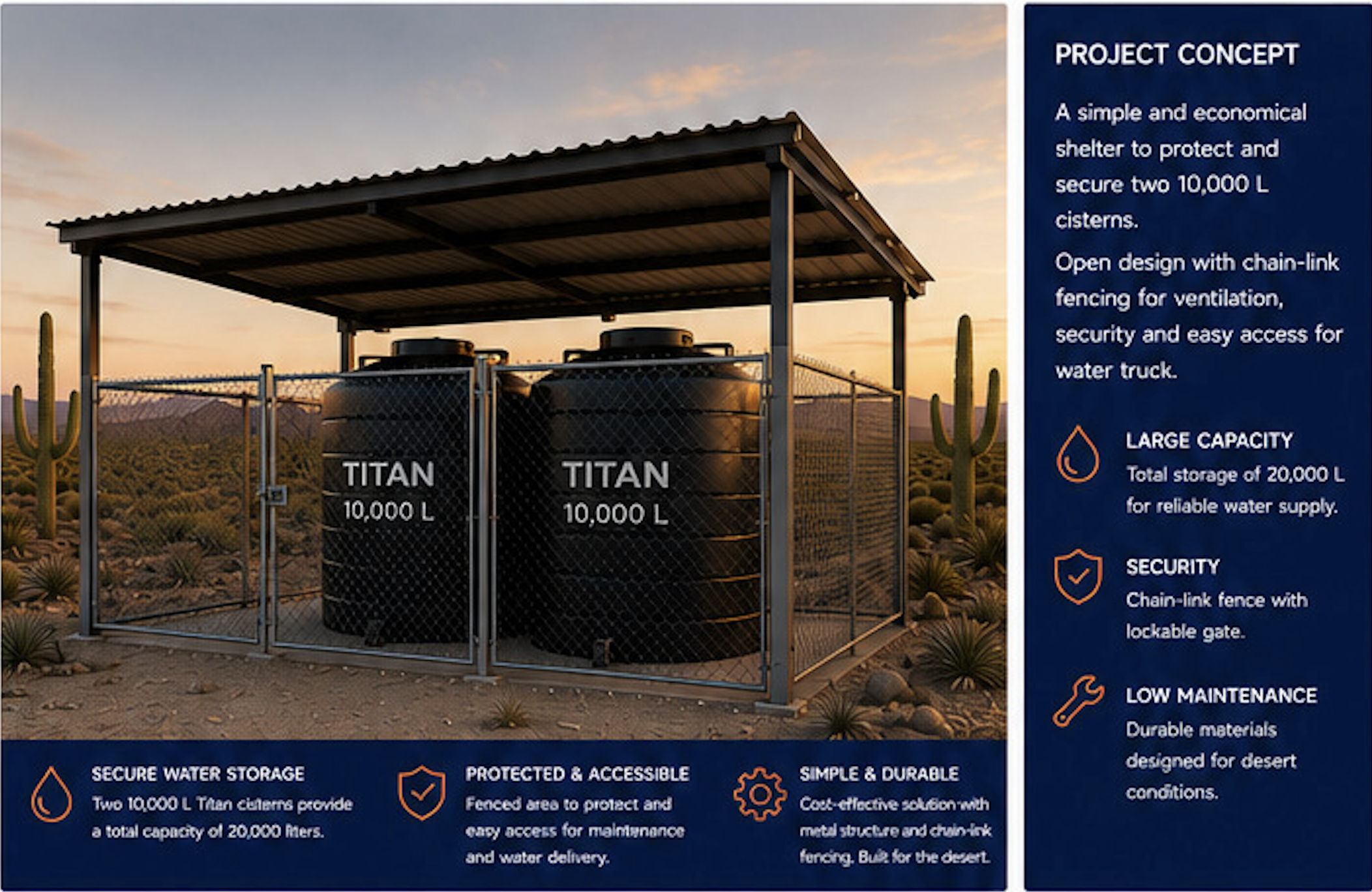
Our future house will be fully supplied with water from two large water tanks each holding 10,000 liters.
The water is delivered by a Pipa and stored in our tank.
We will continue to buy our own drinking water separately.
The water from the tanks is therefore used for the entire household supply:
- Showers
- Washing
- Toilets
- Cleaning
- Garden
And of course, everything you need in everyday life for water.
We only want to take one additional step in the kitchen.
Because that’s where we want to filter the water from our tank in addition.
Not because we assume that the water is fundamentally bad.
But because we simply like to have an extra level of safety when it comes to something as important as water.
The water in Baja isn't the same everywhere.
In our research we quickly realized that you can’t even „the water on the Baja“ can speak.
The Baja California Sur is vast and has different groundwater sources and supply systems.
And even within a region, the water supply can be organized differently.
That also means:
Not every pipa has to necessarily deliver the same water.
And it is precisely this question that interests us especially regarding our own house.
Because we want to know at some point:
Where does the water that our Pipa brings actually come from?
Is the water in La Paz really bad?
That was one of the questions we asked ourselves during our research.
And the answer is more interesting than we initially thought.
The municipal water in La Paz is treated and controlled.
In published studies from COEPRIS in 2024, six samples from storage tanks with already treated water were examined. The results were within the applicable parameters of the Mexican drinking water standard.
We actually found that interesting.
Because it shows:
You can't just say that the water in Mexico is bad or not drinkable.
That would be far too general.
However, even though a flawless water sample from a supply system does not automatically mean that the water at every private tap has the same quality.
Because there's still quite a long way to go between now and then.
Treatment → Pipeline network → Storage tank → Home installation → Water tap
And it is this path that we need to look at a little differently here.
Our chain looks like this
At our house, it will look something like this:
Source / Well
↓
Pipa
↓
Water tanks
↓
Home installation
↓
Faucet
And that brings up a point that we probably wouldn't have even thought about earlier:
the water tanks.
Because water at the source can be perfectly fine and still become contaminated later.
For example, during transport or during storage.
A story that made us think
The father of a friend of ours has been living on the Canary Islands for many years.
He became seriously ill there because a dead animal had gotten into the water tank and the water was contaminated as a result.
Of course, that doesn’t mean that something like this will happen to us.
But the story has stayed with us in our minds.
Because suddenly you realize:
A water tank is not just a large container.
If you store water in it for a long period of time, you must also ensure that this tank is clean, closed, and protected.
And that is exactly why we at our own house not only want to pay attention to this, what goes into the tanks, but also on the, what comes out of it again.
What we have discovered about the Pipas in the vicinity of our future home
In our area, water is sometimes delivered via pipes.
We have found that Pipa operators sometimes replace the well if there are problems with it.
What we haven't been able to find out clearly so far, however:
All the private wells in the area get their water from the same source.
And that's exactly what we want to find out.
Because for us it would of course be interesting to know from which well or spring our Pipa actually draws its water.
Then we could also get much more detailed information about the water quality of this specific source.
We don't want to filter all the house water
Therefore, when planning our house, it was quickly clear to us:
We don't need a huge system that turns every liter of water in the tank into drinking water.
We buy our drinking water separately anyway.
But we would like to process the tank water in the kitchen as well.
That is why we are planning a two-stage filtration.
The first filter should be installed at the house entrance or after the tank.
It is said to remove sand, soil, rust, sediment and other larger particles from the water.
This not only makes the water cleaner, but also protects our entire home installation.
The filter is designed for high flow rates and is therefore generally suitable for complete household use.
He is not supposed to filter out everything in the process.
It is, rather, the first step.
And then comes the kitchen
A second, finer filter is to be installed in the kitchen.
And this filtered connection has several functions for us.
The water should be for Cooking used as water for the animals and also for our Dishwasher is supplied via this filtered connection.
That was important to us.
Because if we are already filtering water, we don't want to just filter the water from a small water tap and then continue to use the dishwasher with unfiltered tank water.
Then it would be better to have the entire kitchen connection receive filtered water.
Therefore, even a small drinking water filter is not enough for us.
In our research, we discovered that many classic under-the-counter filters are actually intended for a single drinking water tap.
For us, that would be too little.
Our filter must ultimately also provide enough water for the dishwasher.
Therefore, in addition to the actual filter performance, what is most important for us is Flow rate and pressure loss Important.
An interesting candidate that we have therefore considered is the Pentair Everpure FC-S Series.
Depending on the cartridge, flow rates of approximately 5.7 to 9.5 liters per minute, a filter fineness of up to 0.2 micrometers, and NSF/ANSI certifications are specified.
However, we do not yet know whether this exact system will ultimately be installed here.
Because we don't just want to buy the most expensive or technically impressive filter.
We want to The right filter for our water.
First, know what is in the water
And that’s exactly why there’s one more thing to consider before making the final purchase decision:
a water analysis.
We would like to know as accurately as possible how our water is actually composed.
Among the things that are interesting to us in this context are:
- TDS or salt content
- Water hardness and limescale
- Fluoride
- Arsen
- Nitrate
- Heavy metals
- Iron and manganese
- and of course the microbiological contamination
Because only when we know what is actually in the water can we decide which filtration technology we actually need.
Perhaps a combination of sediment and fine filters is sufficient.
Perhaps we need additional filter stages.
Perhaps it will also turn out that certain things that we have been thinking about are not at all a problem for our water.
We would rather measure it than guess.
Because we have now learned:
You don’t have to make things more complicated on the Baja.
You just have to know, where your own needs lie – and find a reasonable solution in the right places.