
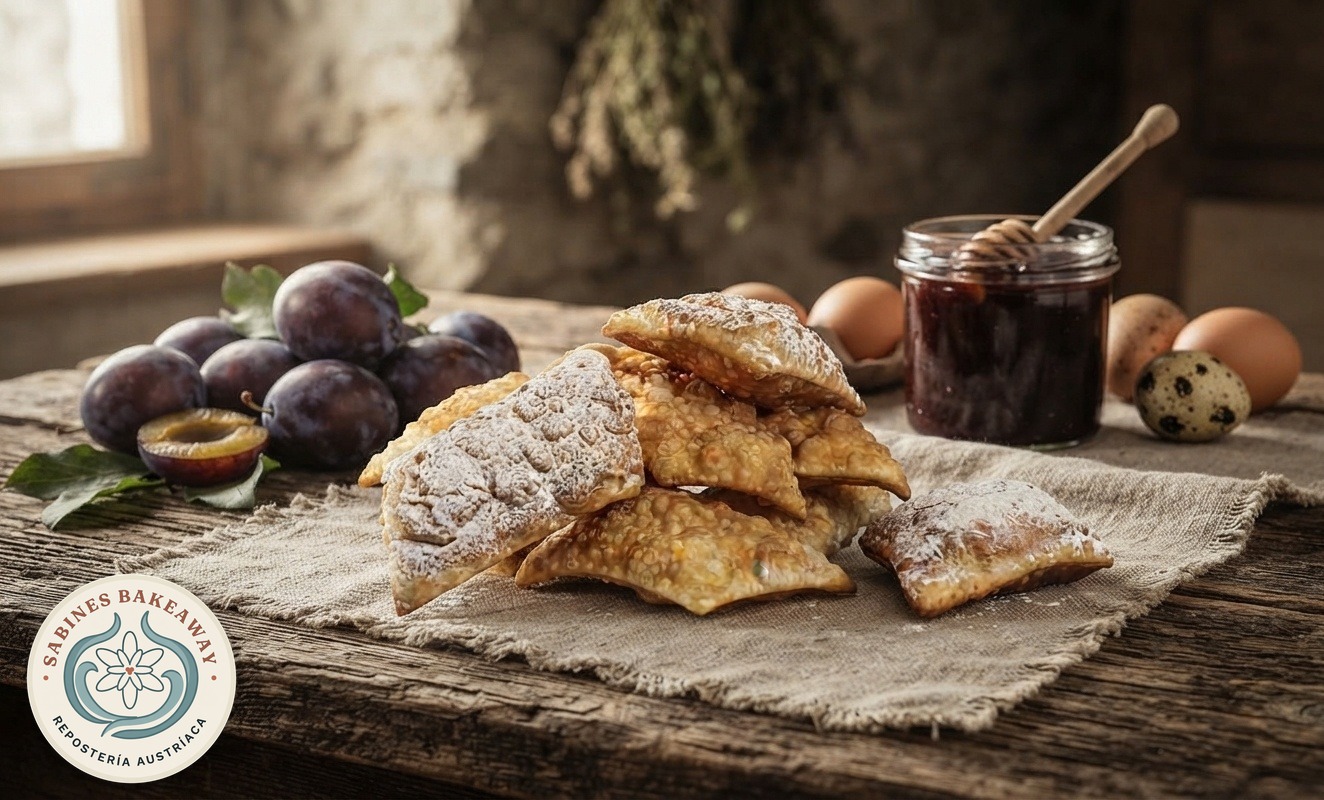
Some pastries just taste good. Others catapult you straight back 40 years into your childhood with the first bite. That's exactly how I feel about Polsterzipf.
I hadn't eaten them for many years – and suddenly there they were again. Fried golden brown, a little misshapen, thickly dusted with powdered sugar, and that smell that instantly takes you back to your mother's kitchen.
For me, Polsterzipf are one of those typically Austrian pastries that have sadly become far too rare today.
And yet they're so wonderfully uncomplicated: a simple dough, a good filling and hot oil – that's all it takes.
Golden brown and crispy on the outside, soft on the inside with a wonderfully juicy filling. That's exactly how they have to be for me.
The dough
The dough itself couldn't be simpler. Butter and milk are warmed together and then kneaded with flour, egg yolk and a pinch of salt into a smooth dough.
It's important to give it its ½ hour of rest. After that it rolls out and handles beautifully.
Ingredients
- 40 g butter
- 118 ml milk
- 300 g flour
- 1 egg yolk
- 1 pinch of salt
- Powidl (Austrian plum butter)
- Egg for brushing
- Oil for frying
- Powdered sugar for sprinkling
Method
- Butter and milk mixture: Warm the butter and milk together and then let cool a little.
- Kneading the dough: Knead the flour, the warm butter and milk mixture, egg yolk and salt into a smooth dough.
- Resting: Let the dough rest covered in a warm place for ½ hour.
- Rolling and cutting: Roll the dough out on a lightly floured work surface to the thickness of a knife back, about 30 × 40 cm, and cut out rectangles of about 8 × 5 cm with a pastry wheel.
- Filling: Place ½–1 tsp Powidl in the middle of each piece of dough. Brush the edges with the beaten egg and fold the pieces into triangles.
- Sealing the edges: Press the edges together firmly, for example with a fork. This creates a nice pattern and keeps the filling safely inside the Polsterzipf while frying.
- Frying: Heat oil about four fingers deep. The oil must not be too hot. Fry the Polsterzipf in several batches, floating, until golden yellow on both sides.
- Draining: Lift them out with a slotted spoon and drain on kitchen paper.
- Dusting: Sprinkle generously with powdered sugar while still warm or lukewarm.
Sabine's Tip – when it comes to the filling, there are no limits to creativity
For me, Powidl is the classic Tyrolean version and therefore belongs in the original recipe.
But if you like, you can refine the Powidl to taste – for example with poppy seeds, chopped nuts or rum raisins. There really are no limits to creativity here.
Another Tyrolean variation is to fry the Polsterzipf without any filling and then serve them with fresh apple sauce.
And then of course comes the most important step: plenty of powdered sugar on top!
Freshly fried and still slightly warm, they're simply unbeatable.
A pastry that doesn't want to be polished or modern, but simply does exactly what it has done for generations: make people happy.
← Back to Sabines Bakeaway – all recipes, prices and ordering