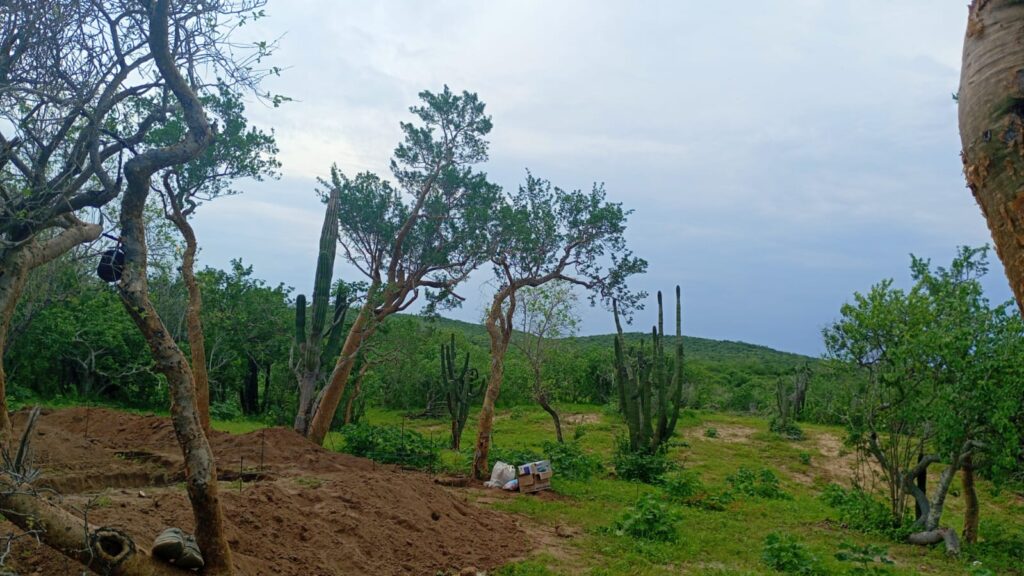
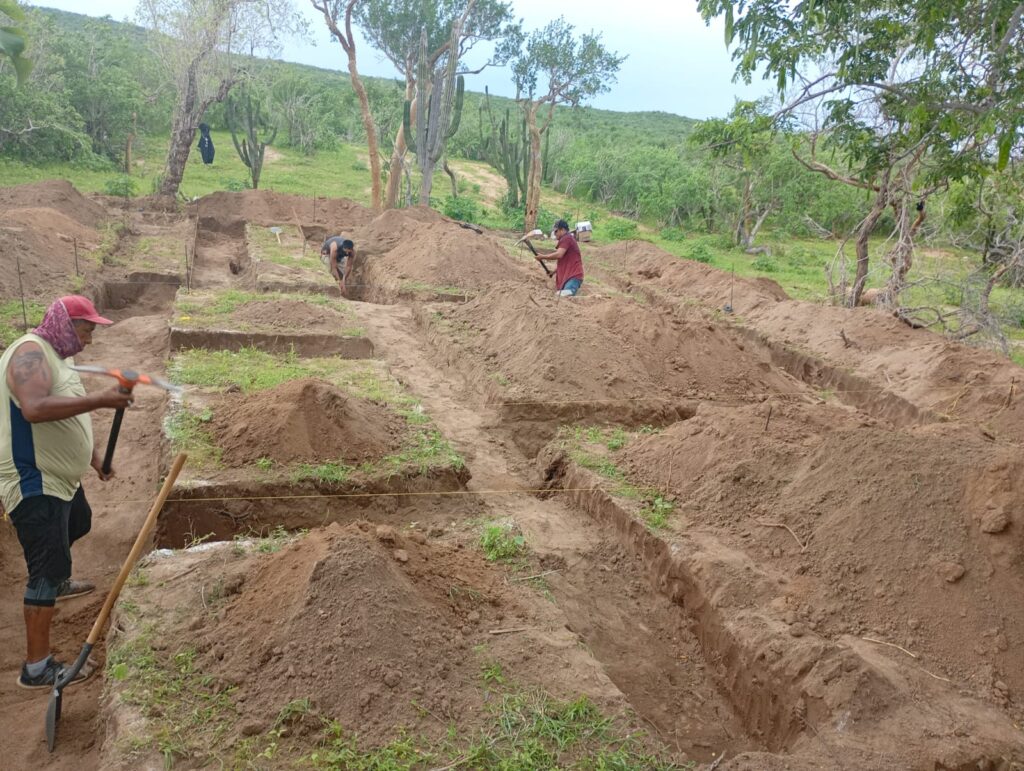
A few days ago we received photos from Andrés of Our construction site.
And to be honest: We were quite confused at first.
Because what we saw in the photos was completely different from what we had previously known about home construction.
No foundation, no walls – nothing we were used to seeing.
Instead, it looked more like a site for the excavation of some kind of archaeological artifact.
We stared at the photos and tried to figure out exactly what we were actually looking at.
Romed finally got to the point and asked Andrés:
„Have you found a dinosaur skeleton on our property?“
Today we had another meeting with Saidee and Andrés. And this time he also explained to us why our construction site actually looks more like an archaeological excavation than a house construction project at the moment.
Of course, Saide had to translate back and forth between Spanish and English again. Andrés’ Spanish is simply unstoppable in terms of speed.
And today the situation became even more difficult:
Both Andrés and Saidee had a brownie in their mouths.
That, however, did not stop either of them from continuing to talk cheerfully.
But that would be the next topic we would be discussing.
Because the brownies weren't there by chance.
Those were actually my first homemade brownies at Baja.
And I have to say: The international jury (Mexican, Canadian and Romed) agreed surprisingly quickly and rated it excellent.
I myself am not quite satisfied yet.
But okay – it was the very first attempt. And it could have gone much further into the pants than just getting a little too dry.
Now we also know what really happened there
But back to the construction site.
What we saw in the photos were not just any holes where archaeologists are looking for remnants of past civilizations.
These are the first steps of our deep groundwater extraction.
Our house is built on concrete piles – in Spanish, pilotes. These are driven deep into the ground until they reach the supporting soil layers. At first, therefore, the whole thing looks rather spectacular but also rather unpresentable: lots of earth, deep holes and concrete piles that seem to protrude from the ground from nowhere.
For us, it initially looked more like „What’s this supposed to be?“.
Now we know: This is exactly what our house will become later on.
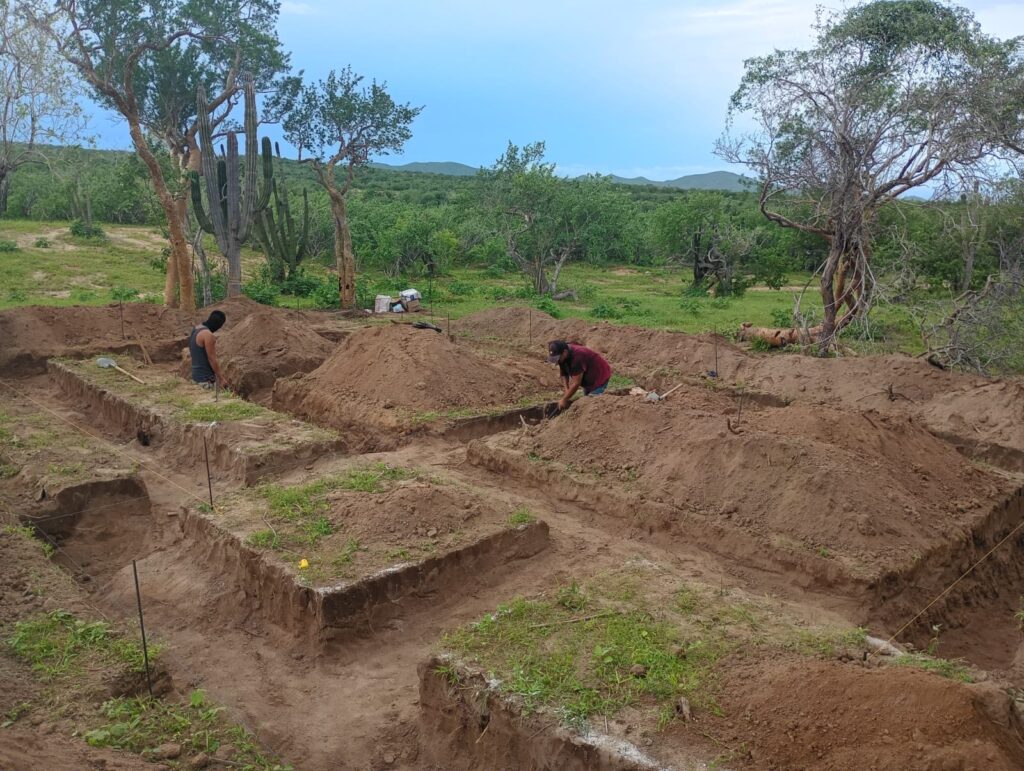
The individual posts are then connected together. Massive horizontal concrete beams are used for this – in Spanish, Contratrabe or Trabe de Liga.
And the steel structure we saw in the pictures also has its good reason. The massive steel beams form the reinforcement and will later be enclosed by concrete. They ensure that the resulting forces can be absorbed accordingly and transmitted to the underground.
Especially here, where the soil is more unstable and earthquakes are part of life, this construction is particularly important.
The sketch also made it clearer to us what we had actually seen in the photos.
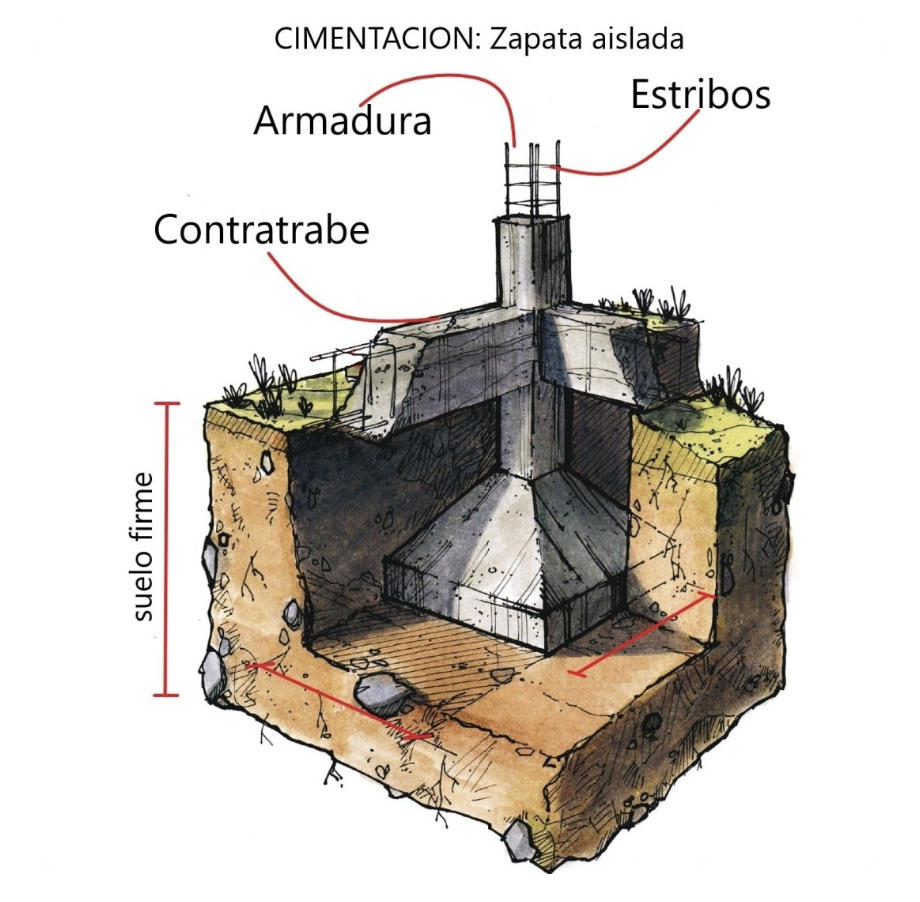
And suddenly it wasn't just any holes anymore.
It was our foundation.
Just one thing, which looks completely different from what we are used to from Austria.
Dispersal due to the rain
The Baja currently has its own plan.
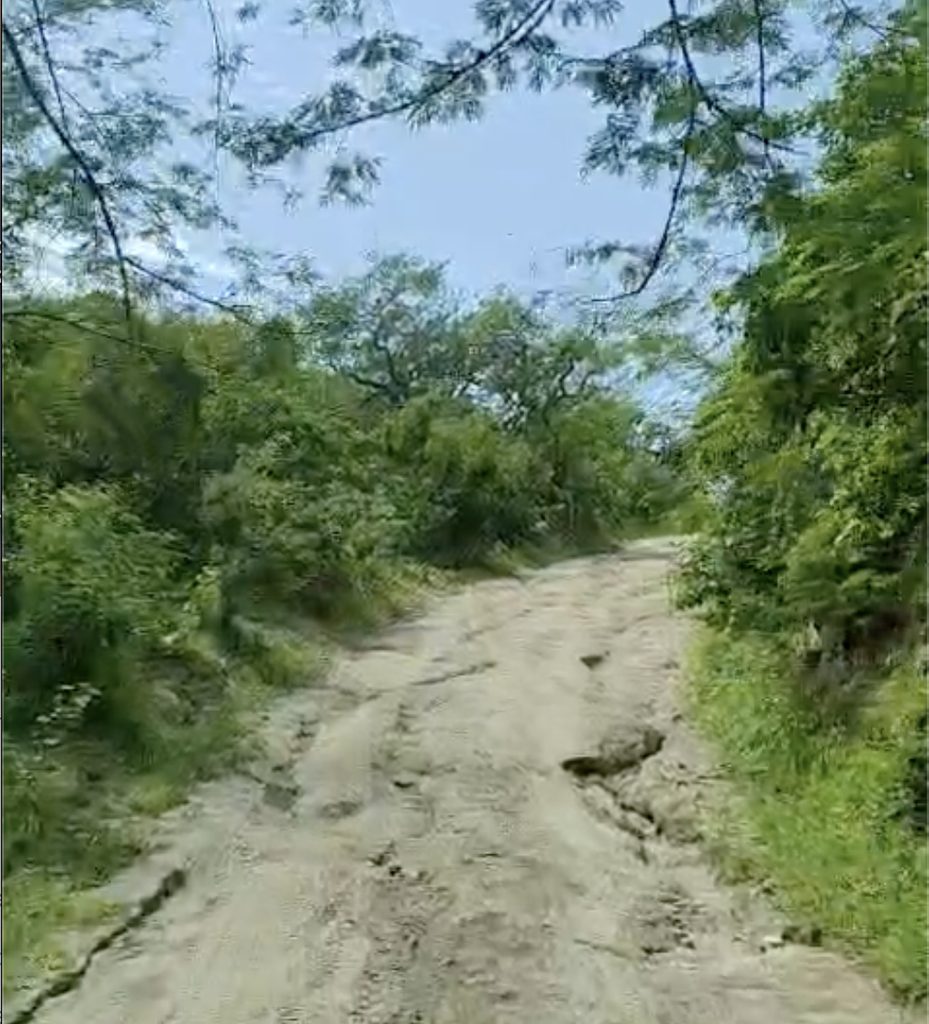
The road to our property has now been cleared and widened. In principle, this is quite good news, because without proper access, building a house in the middle of the wilderness will of course become difficult at some point.
Currently, it rains almost every day.
And it’s then that the path to our house becomes a pretty deep mud path.
The heavy trucks that are supposed to bring the materials to the construction site simply cannot get there at the moment. Their weight is inevitably sinking into the mud.
The workers are on site throughout the week; they have set up a camp.
Only: Without material, they can’t do magic either.
So Andrés quickly rearranged the arrangements.
The steel mats are now being prepared in La Paz, wired, and then transported to the construction site by smaller trucks.
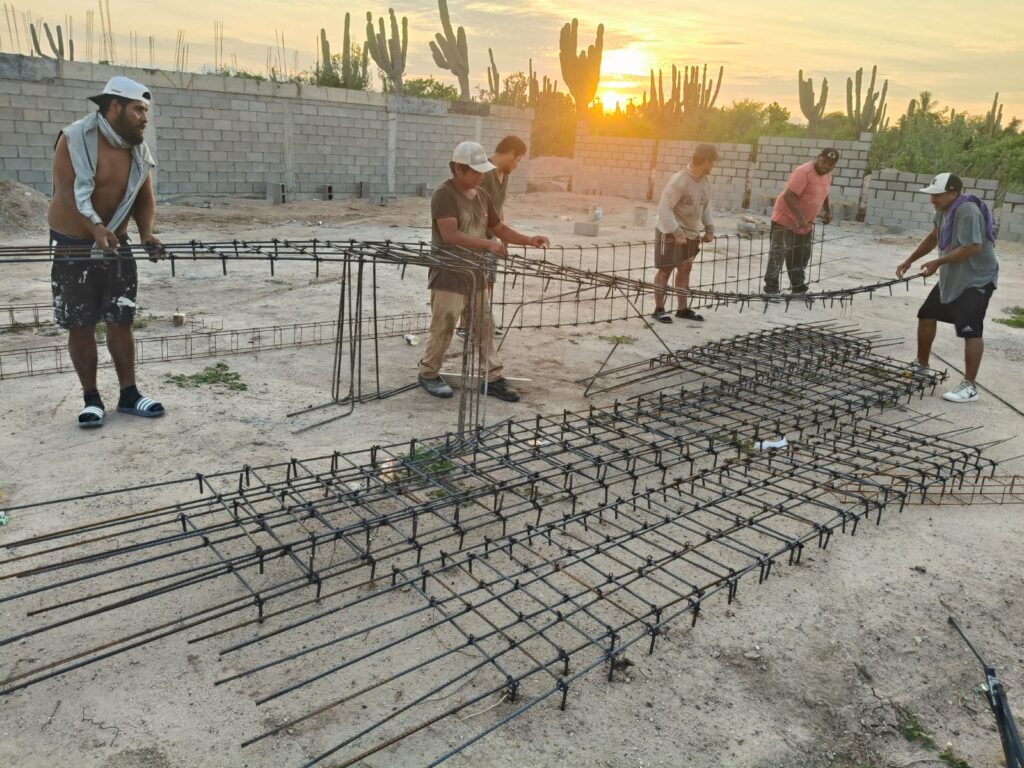
They are much easier to prepare – and that solves the problem of sinking.
What once again impressed us was not so much the technical solution as the way Andrés approaches it.
We had absolutely no knowledge of this problem.
No call.
No news that everything is delayed.
No drama.
No additional costs.
Andrés saw the problem, organized a different solution, and simply told us today that they are doing things differently now.
Oh yeah. We solved that differently now.
Done.
I find it fascinating how things are always solved here, instead of just complaining about why something isn't working right now.
Apparently there is no big „That’s not possible“ here.
Rather an:
„That’s not the way to go about it. Then we’ll do it differently.“
Perhaps that is exactly one of the qualities we like about our new life here.
And then there were the 220 volts
One topic, however, has occupied Andrés much more today than the stalled trucks:
My 220-volt claims.
Originally, 220-volt sockets were intended.
There are now a few more of them.
And that has a pretty simple reason: My little bakery.
Many of the devices I use for this still come from Österreicher and have corresponding 220-volt connections. With the normal 110 volts that are otherwise common here, I can’t get any further.
That means for me quite simply:
Without 220 volts, my small bakery is out of action.
This argument then seemed important enough for Andrés to take the issue further into consideration.
We have also now installed another 220-volt power outlets for things like coffee machines, printers, and even Romed’s battery charging stations; better two too many than one too few.
Now our estimated electricity consumption will be recalculated again.
Therefore, a few additional ones may be added from the very beginning. Solar panels and more battery capacity for that.
It’s actually astonishing how many decisions can be made from a single small outlet.
The topic is also Water filters We have already completed this task today. A filter for sediment is installed directly at the water outlet of our tanks. In the kitchen, an activated carbon filter is also added under the sink, which supplies the water line for the kitchen and the dishwasher as well.
This means that the water is sufficiently purified for our purposes and can be used in the kitchen. However, we will still use purchased water from the large water tanks for drinking. This was the simplest solution for us from the very beginning – and that will not change.
That would therefore clear up this issue as well. Another point less.
Brownies and dark beer
After Andrés solved so many problems for us today, I also got a little involved.
Friends of ours are coming to Baja in October, and I asked them to bring dark beer for Andrés.
He loves dark beer.
And that’s not exactly something you’ll find on every corner here.
So a few bottles from our friends in Europe were practically flown in as personal special construction site supplies.
When you make someone who cares about building our house happy, you really do like that.
And finally, dark beer goes perfectly with my brownies.
I think that sounds like a pretty good working model.
Finally back in the country
Next week we will go to our property ourselves again.
And I can't wait for it.
In the new photos, everything is saturated green. There is blooming everywhere, and you get the feeling that life is in full swing. our 35 hectares it just literally exploded.
That is already a huge difference from the sight we used to be accustomed to a few months ago.
Back then, much of it was dry, dusty, and barren.
Now it seems nature has decided to show everything at once.
And we want to finally see that for ourselves again.
Not in photos.
Not on a video.
But on the spot.
Right in the middle of our future home.
We want to see what has changed, how far the work has actually progressed, and how our property feels now.
And maybe next time we’ll even recognize at once which hole is intended for what.
We are not looking for dinosaurs anymore anyway.