
Have you ever wanted to just move to the seaside and thought that the bureaucracy would sort itself out somehow? That’s exactly the kind of naivety we started with. That’s why we decided to start our own company. Emigrating to Baja California It was at the very top of our list once it became clear that we wanted to move our lives to Mexico. However, between the dream of owning our own plot of land on the Pacific and actually arriving there, there is a lot of paperwork to go through: a residence permit, CURP, RFC, driver’s license – four authorities that have nothing to do with each other and yet all depend on each other. Here we summarize what needs to be done in 2026, with everything we have learned about Baja California.
Baja California: Where exactly do people actually migrate to?
The peninsula in the northwest of Mexico has everything that attracts expatriates: proximity to the US border, mild climate, a coastline on both sides, and several places with established or growing expat communities, including Tijuana, Ensenada, Rosarito, and San Felipe. Ensenada is particularly popular with English-speaking expatriates thanks to its low crime rate, mild climate, and neighborhoods like Bajamar and Punta Banda. Rosarito stands out for its proximity to the US border, especially for people who regularly commute to the USA. San Felipe on the Gulf of California is a rather hidden gem that is only just emerging as an expat destination.
Important to know: Baja California (Norte) with Tijuana, Mexicali, Ensenada and Rosarito is a separate state – and a completely different one from Baja California Sur, where we live with La Paz and Los Cabos. Both states have their own offices, their own fees and in some cases their own rules. Who is eligible to apply for a Emigrating to Baja California If you plan to do so, you should know from the beginning which of the two federal states you will actually land in. How does that work? Living in Baja California We tell in a very concrete way what it feels like for us How our life here actually feels, And why we chose Baja California Sur in the first place, you can find out in Why exactly Baja California Sur? Our decision explains it Read more.
Before we can get down to beach life, however, the bureaucratic part has to be completed. In Mexico, this involves several authorities that have no connection to each other: the Instituto Nacional de Migración (INM) for residency status, RENAPO for the CURP, the SAT for the RFC tax number, and the Secretaría de Hacienda de Baja California for the driver's license. Our honest review of how safe life here really is reveals: Safety in Baja California Sur.
Residence permit: Temporary or permanent resident
For most people, the entry is through the Residente Temporal Mexico (Temporary Residence Permit). This allows you to stay in Mexico for longer than 180 days and up to four years, with the option of renewal or later change to permanent status. The application is first submitted at the Mexican consulate in your home country (for emigrants from Austria, at the relevant consulate), followed within 30 days of entry by converting it into a physical residence card at the INM on site.
After four years as a resident temporal, you are entitled to request a transfer to Permanent Resident of Mexico, which is valid indefinitely and no further extension is required.
Financial requirements (UMA thresholds 2026)
For the most common category, proof of economic protection („solvencia económica“), the following thresholds are in effect for 2026, calculated based on the UMA (Unidad de Medida y Actualización, at 117.31 Pesos per day as of February 1, 2026):
- Monthly income for the last six months of at least 300 days UMA, which translates into approximately 35,000 pesos or about 1,650 US dollars.
- Alternatively, an investment or savings balance of an average of 5,000 day-UMA over the last twelve months, i.e., approximately 587,000 pesos, or about 28,000 US dollars.
These are the most frequently mentioned values – however, during our research we also came across other, sometimes significantly higher, figures. The requirements may vary depending on the consulate, the year, and the individual situation. Please confirm the current valid amounts directly with the relevant consulate or on inm.gob.mx before the appointment, rather than relying on figures from a third party – not even ours.
A realistic assessment of one’s own living costs helps with planning – we go into more detail in our articles. How much money do I really need to move to Mexico? and Is life in Mexico really that much cheaper? explaining it in detail.
Anyone traveling to obtain family reunification, a job offer from an employer registered with the INM, or a non-profit organization’s invitation benefits from reduced or waived fees. However, as of 2026, the INM requires the full fee rate for the issuance of the residence card for all other categories.
Why it often pays to have an attorney on site
The process through the consulate in Austria or Germany is often significantly more bureaucratic than the same process in Mexico. Long wait times for appointments, unclear or changing document requirements, and a lack of experience with individual cases that deviate from the standard procedure are not uncommon. Many immigrants therefore find it easier and faster to have a local lawyer or representative (Spanish:abogado migratorio) accompany them through the process during their stay in Baja California. They know the procedures at the INM delegations in the area exactly and know what documents a caseworker actually requires. The costs vary depending on the law firm and the scope of the assignment, but for many they are already amortized by the time saved and the lower error rate of the application.
The relevant departments in Baja California
Anyone who lands in Baja California (Norte) takes the second step – the conversion of the consulate visas into the physical card – at one of the INM delegations in the state:
- Tijuana: Boulevard Insurgentes No. 16000, Fracc. Los Álamos, C.P. 22110.
- Mexicali: De los Pioneros No. 1005, Palacio Federal, 2nd floor, Civic and Commercial Center, C.P. 21000.
- Ensenada: Blvd. Teniente Azueta No. 130 Int. 23, Col. Centro, C.P. 22800.
- Rosarito (Sub-office): Palacio Municipal, Calle José Haros Aguilar No. 2000, 3rd floor, Office 312.
All four locations had public traffic at the time of our research, Monday to Friday from 9:00 to 15:00. A „cita“ appointment is usually booked in advance online; without one, you won’t get anywhere at any of these places.
Those who land further south on the peninsula, such as in La Paz or Los Cabos, are already in the neighboring state of Baja California Sur – there, the own INM delegation in La Paz takes over the proceedings: Blvd. Agustín Olachea between Blvd. Luis Donaldo Colosio and Calle Chechén, Colonia Las Garzas, C.P. 23079, also Monday to Friday from 9 a.m. to 3 p.m. Again, personal appointment with a pre-booked appointment is mandatory.
Since Baja California borders California directly, the region is one of the most-visited INM zones in the country – those who book their appointment early save themselves from long wait times, especially in Tijuana.
Anyone planning to purchase a property alongside their residence permit will find the legal basis for this in our article. Fideicomiso or company?
CURP Mexico: The personal code that you don't have to apply for separately
Who does that Emigrating to Baja California Specifically, it plans to come up with CURP Mexico It’s not over yet. The CURP (Clave Única de Registro de Población) is the 18-digit personal identification code that almost every authority in Mexico requires—from the tax number to the driver’s license. For foreigners with a pending residency procedure, there is good news here: The CURP is usually generated automatically as soon as the residence application is processed with the INM, because the systems of INM and RENAPO (Registro Nacional de Población) are interconnected. A separate application is usually not necessary.
One change for 2026 that you should know about: Since February 2026, Mexico has been gradually rolling out the biometric CURP, which includes fingerprints, a photo, and a digital signature, and is intended to replace the traditional paper form at central „high-value“ government offices. However, the transition is taking place in stages and not nationwide from day to day – how far it is mandatory in a given place and for a specific process is constantly changing. Anyone who does not already have their CURP in the new form should do so at their next opportunity (such as at the INM appointment or at the Registro Civil), as some agencies – including driver’s license offices in Baja California – are now requiring or preferring the new version. However, the current situation is no different from a brief inquiry on the spot.
RFC Mexico: The tax number for everything that has to do with money
For anyone who wants to use emigration to Baja California for professional purposes, sooner or later the path leads through Tijuana. RFC Mexico. While the CURP confirms identity, the RFC (Registro Federal de Contribuyentes) is the tax identification number. Anyone who receives a salary, issues invoices, or wants to register a business in Mexico must have the RFC. The prerequisite for applying to the SAT (Servicio de Administración Tributaria) is first the CURP – without it, nothing can be done.
To apply for an RFC as a foreigner, you need: a valid residence document (Residente card or Border Worker card), the CURP, and proof of address in Mexico, such as a utility bill or internet or rental contract. The appointment is booked online through the SAT portal; there are SAT offices in Baja California, including in Tijuana and Mexicali.
We want to make one point explicitly clear here, because the old information persists: For a long time, the RFC was practically considered mandatory for every Mexican bank account. In April 2026, the Mexican government removed this requirement for simple, transactional basic accounts – banks are now allowed to open such accounts even without the RFC. For more extensive accounts, such as the salary account at the employer, invoicing, or a self-employed business, the RFC remains practically indispensable, and individual banks often still require it in practice. Anyone who only needs a simple account to get started should ask the preferred bank directly about what is actually required at the moment, rather than relying on older information – not even this paragraph, once it is a few months old.
Baja California driver's license: Re-write or get a new one?
Even the Driving license in Baja California For most people who are actually considering emigrating, it is one of the first steps they take locally. There is no unified, formal „Canje“ agreement at the national level that automatically exchanges a foreign driver’s license for a Mexican one—the regulation lies with the states.
Many immigrants on the Baja Peninsula report that a valid foreign driver's license can be easily converted at the Recaudación de Rentas offices without having to take the theory or practical exam again. However, in our research we also came across indications that the official requirements of the Secretaría de Hacienda generally stipulate a passed theoretical and practical exam – and that agents who promise a „guaranteed pass“ without one are not always being honest. Our advice: If you plan to take the exam for safety's sake, even if you hear from other immigrants that it went smoothly for them. What is actually required at the respective counter can also vary from municipality to municipality and from agent to agent.
Anyone who cannot present a valid foreign driver's license will still have to apply for a new license, including taking the theory and practical tests.
Requirements for foreigners
- Valid proof of residence (FMM, Residente Temporal or Permanente) and passport.
- Proof of address in Baja California, no older than three months (electricity, water, internet, telephone or bank statement).
- Medical certificate on fitness to drive, issued by a public or private health institution.
- Official photo ID – for foreigners, typically a passport or Matrícula Consular.
- Successful completion of the theoretical and practical driving test with a vehicle that is approved for the respective driver's license type.
The procedure on site: book an appointment online through citas.ebajacalifornia.gob.mx in the relevant municipality of residence, submit documents at the counter, have fingerprints and a photo taken, have any medical examination performed on site if necessary, take exams, pay the fee, and pick up the driver's license.
Regarding proof of residence, we came across two different requirements: according to official guidelines, regular proof of address must not be older than three months. In addition, there apparently is also the option to present a proof of residence from the municipality, which certifies a stay of at least six months in Baja California. We were unable to conclusively determine whether and when which proof is required – the best way to find out is to directly ask your relevant Recaudación de Rentas before scheduling your appointment.
Costs for the Licencia de Conducir (as of July 2026, Baja California/Norte)
- Motorist: 3 years 1,120.10 Pesos, 5 years 1,493.46 Pesos.
- Driver C: 3 years 1,278.13 Pesos, 5 years 1,704.18 Pesos.
- Drivers A, B and D: 2,107.50 Pesos.
- Temporary driver's license (for motorists, motorcyclists or drivers C, also for foreigners) for up to 9 months: 959.54 Pesos.
Important: These rates apply to Baja California (Norte), with the cities of Tijuana, Mexicali, Ensenada, Tecate, and Rosarito. Baja California Sur (La Paz, Los Cabos) has its own fee system and sometimes different durations – anyone commuting between the two states should not confuse the two. Fees change regularly; it’s worth checking the current rates before the appointment in any case.
Those who are only visiting Baja California for tourism purposes or for a shorter period can alternatively apply for one of the temporary options (3, 6 or 12 months, depending on their status of residence), without having to go through the full process at once.
Our experience with the Mexican bureaucracy
Before we emigrated, we were all warned that the Mexican bureaucracy was hardly comprehensible to Europeans; it was complicated and nerve-wracking. With exactly this expectation, we went to our first official appointment.
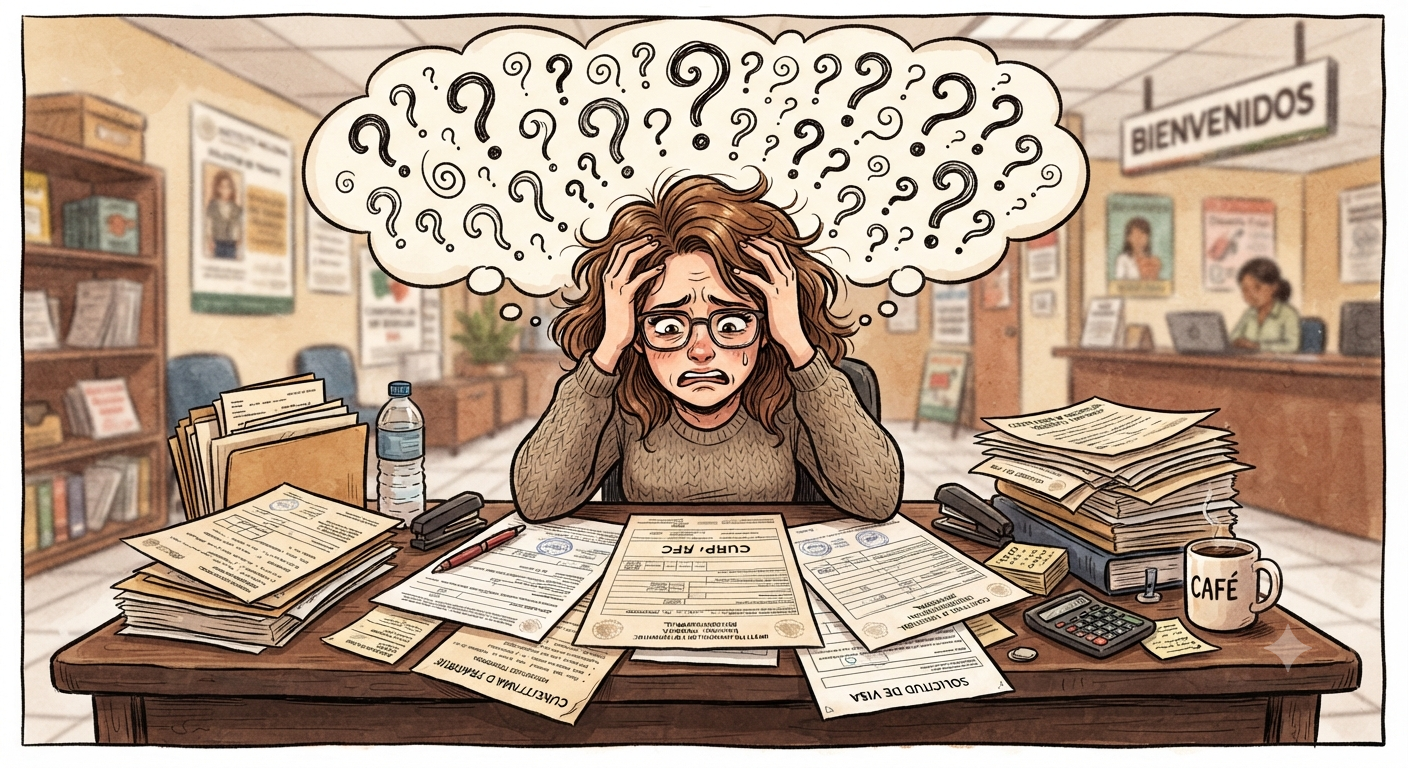
What awaited us was actually quite time-consuming – just different than we thought. It seems that four or five employees are involved in each application. You take a waiting number, are sent to the next counter, where you get a stamp, go back, then continue to the next station. Most often there is a photo and fingerprint scan, of course with another person. In between: scanning documents, filling out forms, making copies, and apparently printing twenty more pages. What in Austria is often done with one appointment and one form can take a full day in Mexico and several stations.
What always surprises us positively about our interactions with the authorities is the helpfulness of the staff. They will call in a colleague to explain something, translate technical terms at the drop of a hat with their mobile phones, and more than once someone has even apologized for not speaking better English – when in fact we are the ones in the wrong here, needing to speak better Spanish. Our own experience: be patient, be friendly with the people at the counter, and if possible, make some time for small talk in the waiting area. This makes the half-day of duty noticeably easier. More of our experiences with authorities in Mexico can be found in our post Bureaucracy in Mexico?!
Rational order when moving to Baja California
In practice, this sequence has proven effective:
- Apply for a consulate visa for the temporary or permanent resident in their home country.
- After entering the country within 30 days, go to the relevant INM delegation in Tijuana, Mexicali, Ensenada or Rosarito (or La Paz in Baja California Sur) to pick up the residence card – in this case, the CURP is usually generated automatically as well.
- Apply to the SAT with a CURP and residence card, as well as proof of address, as soon as it becomes necessary.
- As soon as a permanent residence in Baja California can be proven, the driver's license exam at the local Recaudación de Rentas can be taken.
Those who follow this sequence when emigrating to Baja California avoid the most common delays – such as attempting to apply for an RFC without a CURP or a driver's license without a valid residence card.
Note: Fees, thresholds, and regulations change regularly in Mexico, and practices can vary among individual agencies and employees. We researched all the information in this article to the best of our knowledge, but we are not lawyers or tax advisors. Before any appointment, it is worth checking the official websites of INM (gob.mx/inm), SAT (sat.gob.mx), and the Secretariat of Hacienda Baja California (retys.bajacalifornia.gob.mx) to confirm the current valid values – and, if in doubt, asking a quick question directly at the relevant agency.
Sources
- Residencia Temporal in Mexico: Complete Guide to the 2026 Process
- Temporary Residence Requirements in Mexico — Guide 2026
- Migration Rights in Mexico 2026: Fees and Discounts from the INM
- INM Representation Office in Baja California
- BAJA CALIFORNIA FEDERAL INM DELEGATION (PDF)
- CURP for Foreigners in Mexico 2026: Procedures and Requirements
- CURP biometric 2026: key procedures where it will be mandatory throughout Mexico – El Universal
- RFC for foreigners: requirements and how to apply – Wise
- Register with the RFC as an individual if you are a foreigner – SAT
- Opening bank accounts in Mexico: goodbye to the RFC (April 2026) – El Informador
- Driving License Expeditions – RETYS Baja California
- Confirmed in Baja California: prices for the driver's license in June 2026
- UMA 2026 in Mexico: daily, monthly and annual value – INEGI
- Is Ensenada, Baja California, a good city for expats and retirees?
- Speaking Communities in Baja California
- INM Representation Office in Baja California Sur
- INM in La Paz – Baja California Sur (Offices, Phone numbers and Hours)
- Frequently Asked Questions – Driving Licenses, BC Ministry of Finance
- Driving License in Mexico for Expats | Complete Guide 2026 – AutoviaTest
By the way: We have detailed information on all aspects of national elections, residence permits, and documents in our Checklists for emigration to Mexico collected.